In 1959, Volkswagen had a problem. Actually, several. Their car was small. Americans wanted big. Their car looked strange. Americans wanted chrome fins, long hoods, and enough steel to survive re-entry from space. Their car was German. And World War II had ended only fourteen years earlier.
If you were making a list of things not to lead with in an advertising campaign, Volkswagen had accidentally collected all of them.
Most companies would have done what companies usually do when they’re uncomfortable. Hide the awkward bits. Find better angles. Use bigger photos. Write longer headlines. Pretend the problem doesn’t exist.
Instead, Volkswagen hired Doyle Dane Bernbach. And DDB did something that still feels reckless sixty-seven years later. They looked directly at the problem. Then built the campaign around it. (Wikipedia)
The Car Nobody Should Have Wanted
To understand how strange this was, you need to understand America in the late 1950s. Cars were getting bigger every year. Manufacturers competed on size, horsepower, chrome, and spectacle. Advertising followed the same logic. Everything was bigger. Everything was louder. Everything was trying very hard to impress you.
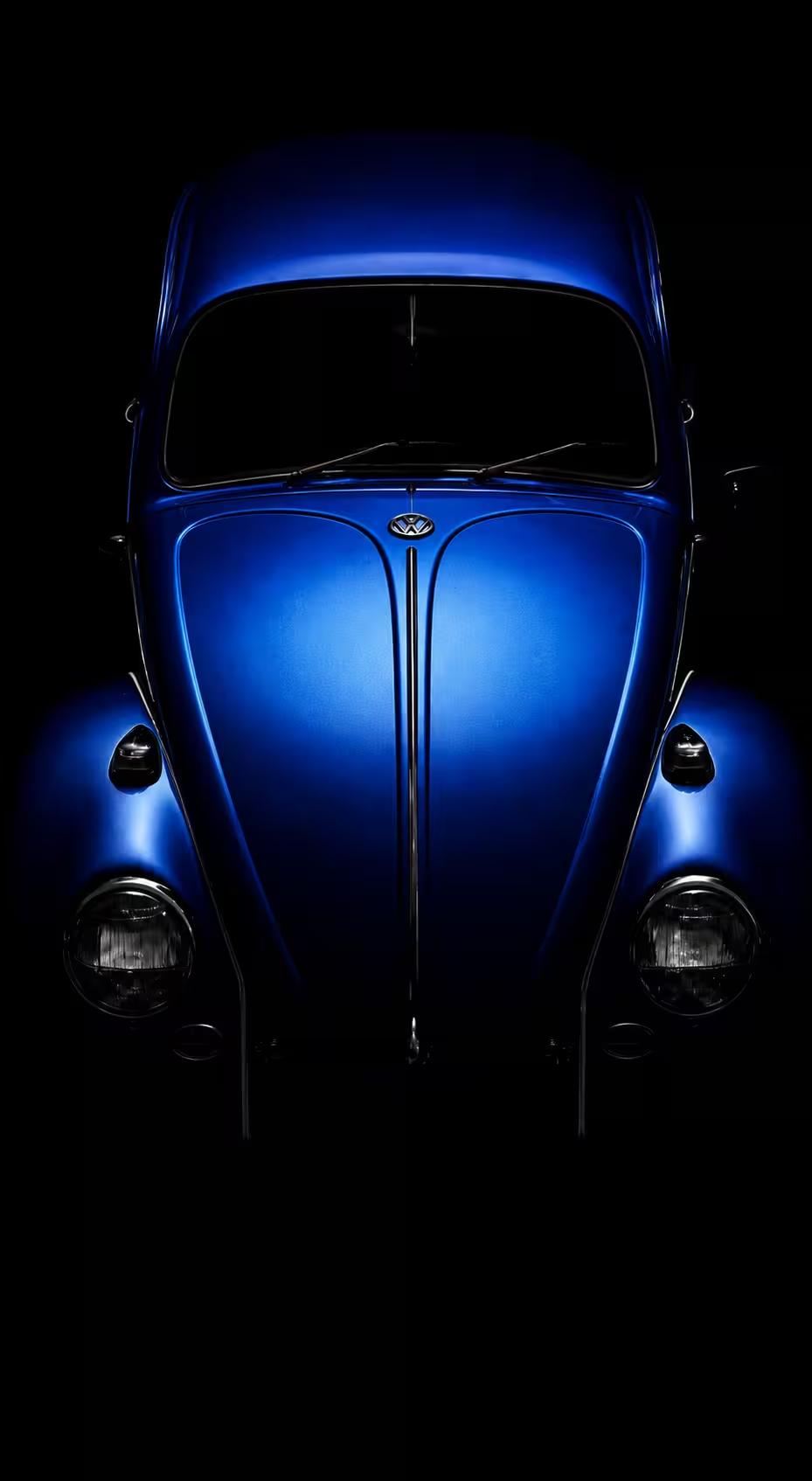
Then Volkswagen arrived with a Beetle. Small. Round. Odd-looking. And unapologetically practical. (Wikipedia)
It was like showing up to a bodybuilding competition carrying a yoga mat. On paper, it made no sense. Which is exactly why it worked.
Think Small
The first shock wasn’t the headline. It was the amount of empty space. Most car ads of the era filled every inch of the page. Volkswagen ran ads where the car looked almost lost. Tiny Beetle. Huge white background. Two words. Think Small. That was it. (Brandvelle)
The ad wasn’t trying to convince people the Beetle was secretly big. It wasn’t pretending the limitation didn’t exist. It simply asked a question nobody else was asking.
What if small wasn’t the problem? What if it was the benefit?
Suddenly, being small meant easier parking. Lower running costs. Better fuel economy. Cheaper insurance. The thing that looked like a disadvantage from one angle became an advantage from another. Not because the product changed. Because the story did.
Then They Called Their Own Car a Lemon
And somehow, they weren’t finished. One of the most famous ads in history carried a single headline: “Lemon.”
For a car company, that’s roughly equivalent to opening a restaurant and leading with: “Food poisoning.”
A lemon, in automotive language, means a defective car. A bad one. The one nobody wants. So naturally, Volkswagen put the word in giant letters at the top of the page. (CNBC)
The copy then revealed the twist. The car shown in the advertisement had been rejected during quality inspection because of a tiny blemish on a chrome strip. Most manufacturers would have shipped it. Volkswagen wouldn’t.
The ad wasn’t about a bad car. It was about standards so obsessive that customers never even saw the cars that failed them. (CNBC)
One word transformed from criticism into proof. The insult became the evidence. And people remembered it. Because nobody else was brave enough to say it.
Why The Campaign Changed Advertising
The campaign would later be ranked by Ad Age as the greatest advertising campaign of the twentieth century. (Wikipedia)
Not because it had the best artwork. Not because it had the biggest budget. Not because Volkswagen suddenly became a different company.
It changed advertising because it treated people like adults. It assumed customers were smart enough to recognise reality. The Beetle was small. Everybody could see that. So instead of arguing against reality, Volkswagen built on top of it.
The campaign didn’t create trust by looking perfect. It created trust by sounding honest. (The Drum)
That was revolutionary. And it still is.
The Mistake Most Small Brands Make
A founder tells us they’re a one-person team. Then spends six months trying to look like twenty.
A business has no office. So every piece of marketing bends itself into knots trying not to mention it.
A startup has less experience than the industry giant. So it copies the giant’s tone, design, language, and positioning.
The result is usually the same. A smaller version of somebody bigger. And nobody remembers that. Because people don’t remember perfect. They remember specific.
Volkswagen understood something most brands still struggle with. The thing everybody notices first is often the thing you should talk about first. Not last.
The Real Lesson
The lesson from “Think Small” isn’t that every weakness is secretly a strength. Sometimes a weakness is just a weakness. The lesson is that hiding it rarely makes it disappear.
Your customers can usually see the thing you’re trying not to mention. The small team. The unusual background. The niche focus. The lack of polish. The weird origin story. The unconventional process.
The question is not whether people notice it. The question is who gets to tell the story about it. You? Or them?
Volkswagen chose to go first. They pointed directly at the thing everyone else thought would hurt them. Then they explained why it mattered.
That is what made the campaign powerful. Not the copy. Not the design. The honesty.
Because the moment you stop spending energy hiding what makes you different, you can finally start using it. And that is usually where the interesting brands begin.